
Revoke a Grant
Cut off an Application's access on behalf of a User by revoking a grant, from the Console or the management API.
A grant records that a User authorized an Application to reach a specific Resource on their behalf. When a User approves an Application on a consent screen, Keycard stores a grant that captures the Resource, the Provider behind it, and the scopes approved. From then on, Keycard issues credentials for that access without prompting the User again.
Revoking a grant withdraws that authorization. You’d do this when:
- Offboarding a person or decommissioning an Application.
- A compromised or misbehaving agent needs to be cut off.
- An Application ended up over-scoped and you want to force it back through consent.
- You’re wrapping up a proof of concept and want to clean up the access it accumulated.
Who can revoke grants
Section titled “Who can revoke grants”Grants live in your organization, and revoking one is a management operation, so it requires a management role:
- Admins (organization-wide) and Managers of a custom Zone can view and revoke grants for people in that scope.
Viewers are read-only: they can see grants but not revoke them.
Before you begin
Section titled “Before you begin”- Sign in to the Keycard Console with an Admin or Manager role.
- Know which person holds the grant. Grants are managed per User from the People page.
- People and grants live in your organization by default. If the access was granted in a custom Zone, switch to that Zone from the Zones page first.
- For the management API, have your organization’s
<zone-id>(its org Zone) and a service-account token.
Revoke a grant
Section titled “Revoke a grant”-
Open the person’s profile
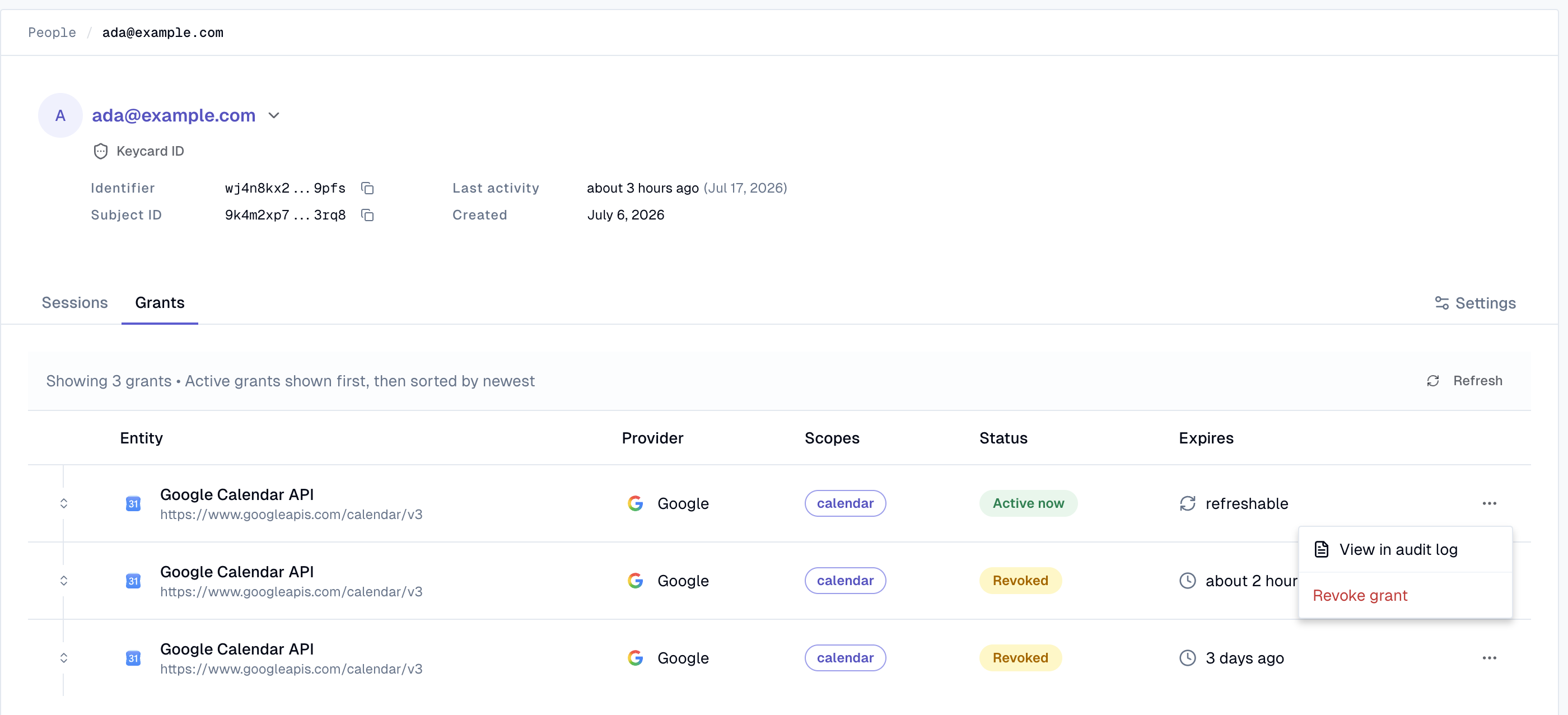
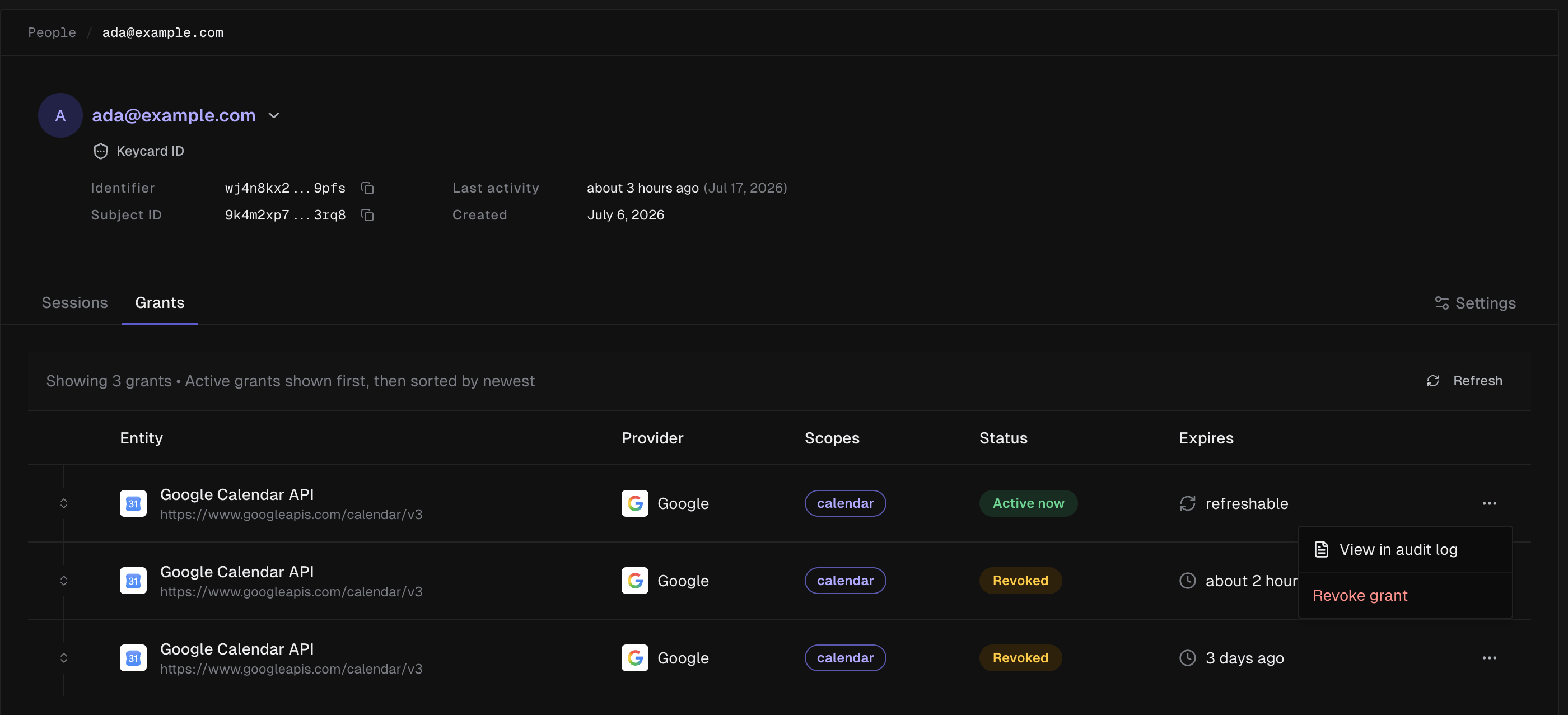
In the left nav, go to People and click the person whose access you want to withdraw. Their profile shows their identifiers, last activity, and two tabs: Sessions and Grants.
-
Open the Grants tab
Select Grants. Each row is one grant, showing the Entity (the Resource, such as
Google Calendar API), its Provider, the approved Scopes, a Status (Active noworRevoked), and when it Expires (for example,refreshable). Active grants are listed first. -
Revoke the grant
On the grant’s row, open the actions menu (⋯) and choose Revoke grant.
-
Confirm the status flipped
The grant’s Status changes to Revoked. Use Refresh if the list doesn’t update immediately. See Verify the revocation to confirm the effect on live traffic.
All management API requests use a Bearer token obtained from your service account’s client credentials. If you haven’t set that up, follow the Authenticate step in Access Policies — the same token works here. In the paths below, <zone-id> is your organization’s Zone (its org Zone), or a custom Zone’s ID if the grant lives there.
-
List the grants in the Zone
Find the grant you want to revoke. Filter by the person’s user ID, and optionally
status=active.curl "https://api.keycard.ai/zones/<zone-id>/delegated-grants?user_id=<user-id>&status=active" \-H "Authorization: Bearer $ACCESS_TOKEN"Each entry in
itemshas anid— that’s the grant you’ll revoke. -
Revoke the grant
Set the grant’s status to
revoked. This mirrors the Console’s Revoke grant action: the grant stays listed with Status: Revoked.curl -X PATCH https://api.keycard.ai/zones/<zone-id>/delegated-grants/<grant-id> \-H "Authorization: Bearer $ACCESS_TOKEN" \-H "Content-Type: application/json" \-d '{"status": "revoked"}'To permanently remove the grant instead of marking it revoked, send
DELETEto the same path — it returns204 No Content.
All management API requests use a Bearer token obtained from your service account’s client credentials. See the Authenticate step in Access Policies for the full token exchange. Here zone_id is your organization’s Zone (its org Zone), or a custom Zone’s ID if the grant lives there.
-
List the grants in the Zone
grants = requests.get(f"{base}/zones/{zone_id}/delegated-grants",headers=headers,params={"user_id": user_id, "status": "active"},).json()for grant in grants["items"]:print(grant["id"]) -
Revoke the grant
Set the grant’s status to
revoked— the same action as the Console’s Revoke grant:requests.patch(f"{base}/zones/{zone_id}/delegated-grants/{grant_id}",headers=headers,json={"status": "revoked"},)To permanently remove the grant instead, use
requests.delete(...)on the same path.
What happens after you revoke
Section titled “What happens after you revoke”Revoking a grant stops Keycard from issuing new access for that User and Resource. It does not reach out and invalidate credentials that are already in the wild.
New credential requests stop. The next time the Application asks Keycard for a credential for that access — a fresh token exchange or a refresh — Keycard has no grant to satisfy it and the request fails with insufficient_authorization (an OAuth2Error) and the message User authorization is required for resource <resource-url>. The User has to authorize the access again before anything is issued, so the Application should treat this as a re-authentication prompt.
Already-issued credentials live until they expire. Keycard issues short-lived credentials, but there is no per-token kill-switch today. A token the agent already holds keeps working against the Resource until it expires on its own. In practice, access stops within the lifetime of the current credential — not the instant you click Revoke grant.
Refresh stops. A grant that shows refreshable in the Console can mint new credentials without re-prompting the User. Revoking the grant ends that — refresh attempts fail, so the Application can’t quietly extend its access past the current token.
Brokered credentials are a special case. For brokered access to an external Provider (Google, GitHub, and so on), revoking the Keycard grant stops Keycard from brokering new credentials — but it does not sign the User out at the Provider or revoke a token the Provider already issued. To fully cut off external access, also revoke Keycard’s access from the Provider’s own connected-apps settings.
What the agent or Application sees. The current token keeps working against the Resource until it expires; after that, the Application can no longer obtain a new credential. Its next token request to Keycard fails with insufficient_authorization — the User must re-authorize. That’s distinct from access_denied, which is what a policy denial returns.
Cut a person off entirely
Section titled “Cut a person off entirely”When you’re offboarding someone or responding to a compromise, revoking grants one at a time is slower than you want. From the People page, open the person’s access drawer (the ⋯ on their row) and use the Danger zone:
- Disable user blocks the person from signing in or obtaining new credentials while keeping their account and configuration intact. It’s reversible.
- Remove from organization removes the person entirely.
You can’t disable or remove yourself.
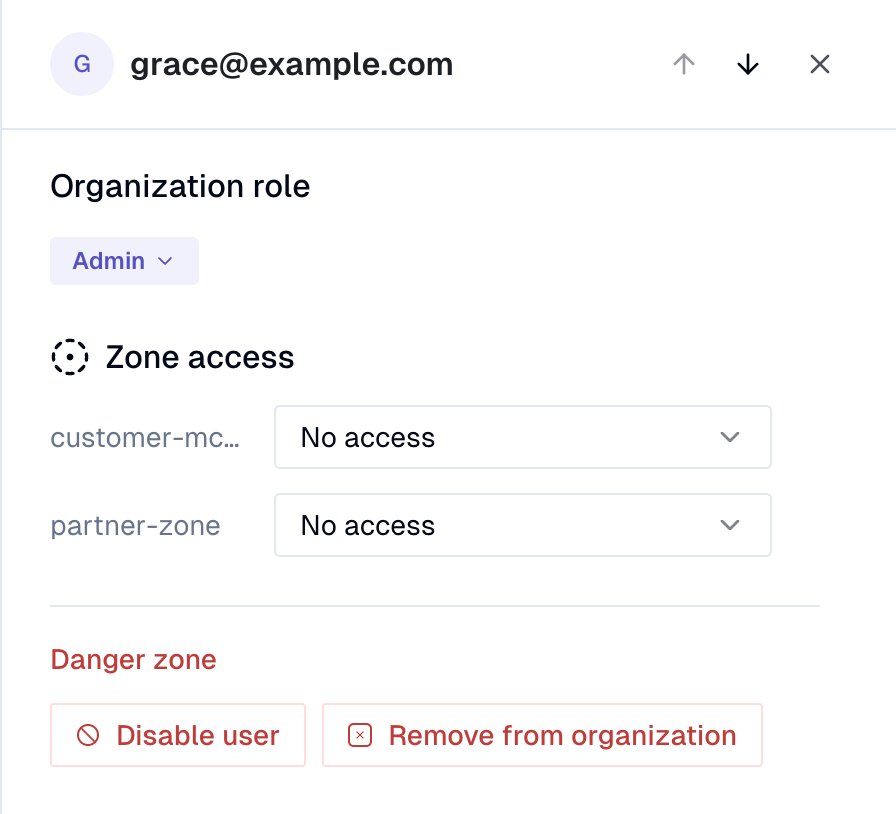
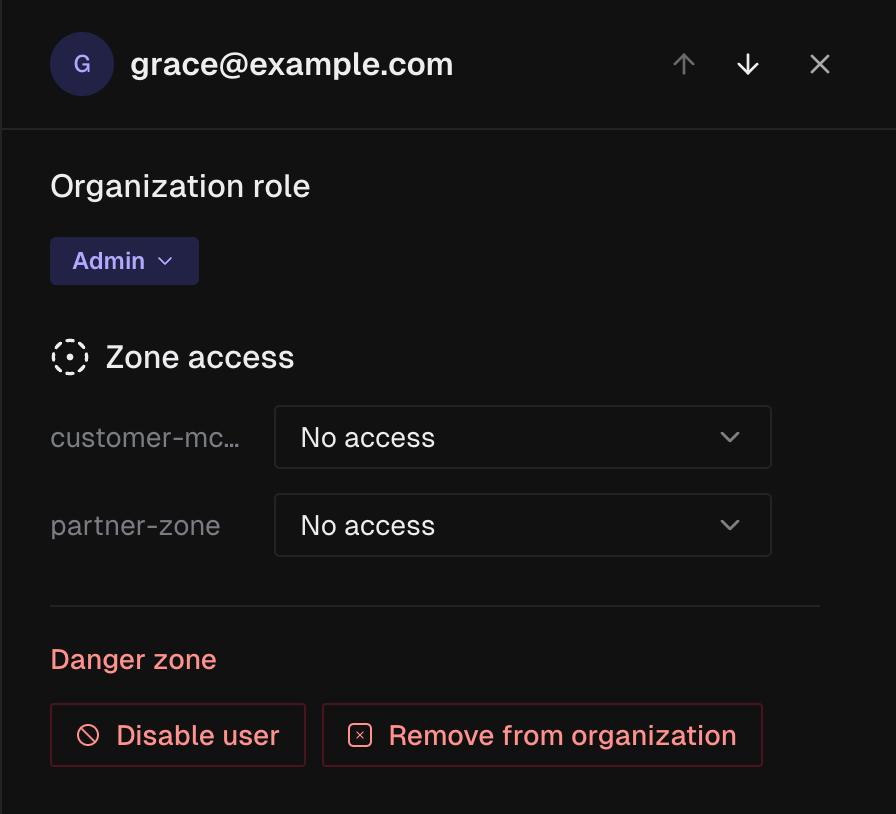
Disabling or removing a person stops new credential issuance the same way revoking a grant does; credentials their Applications already hold keep working until they expire.
Verify the revocation
Section titled “Verify the revocation”-
Check the grant status. On the person’s Grants tab, the revoked grant now shows Status: Revoked.
-
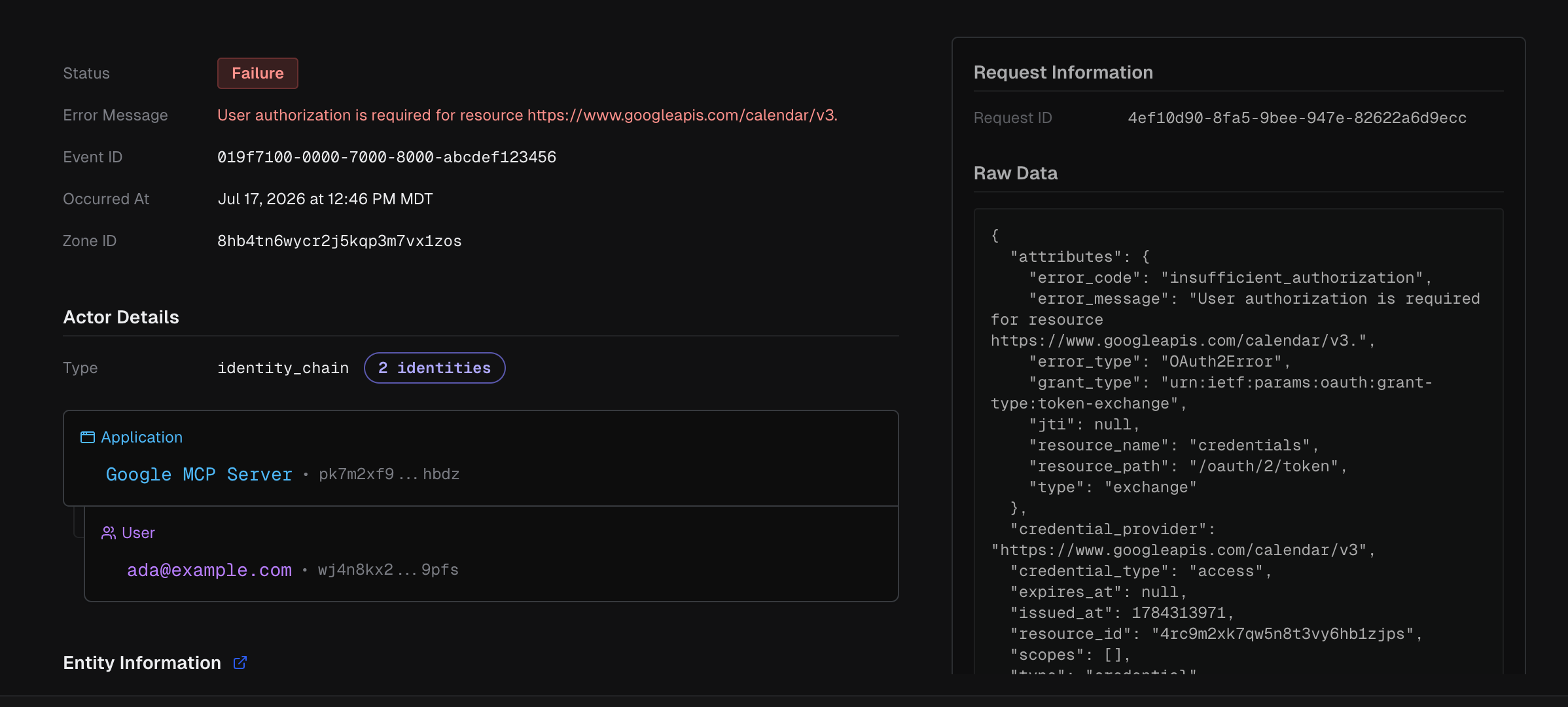
Check the Audit Log. From the grant’s actions menu, choose View in audit log, or open the Audit Log directly. After revocation, the Application’s next attempt shows as a Failure on the credential exchange (resource path
/oauth/2/token), with error codeinsufficient_authorizationand the message User authorization is required for resource<resource-url>. The event’s actor is the full identity chain — the Application and the User it acted for.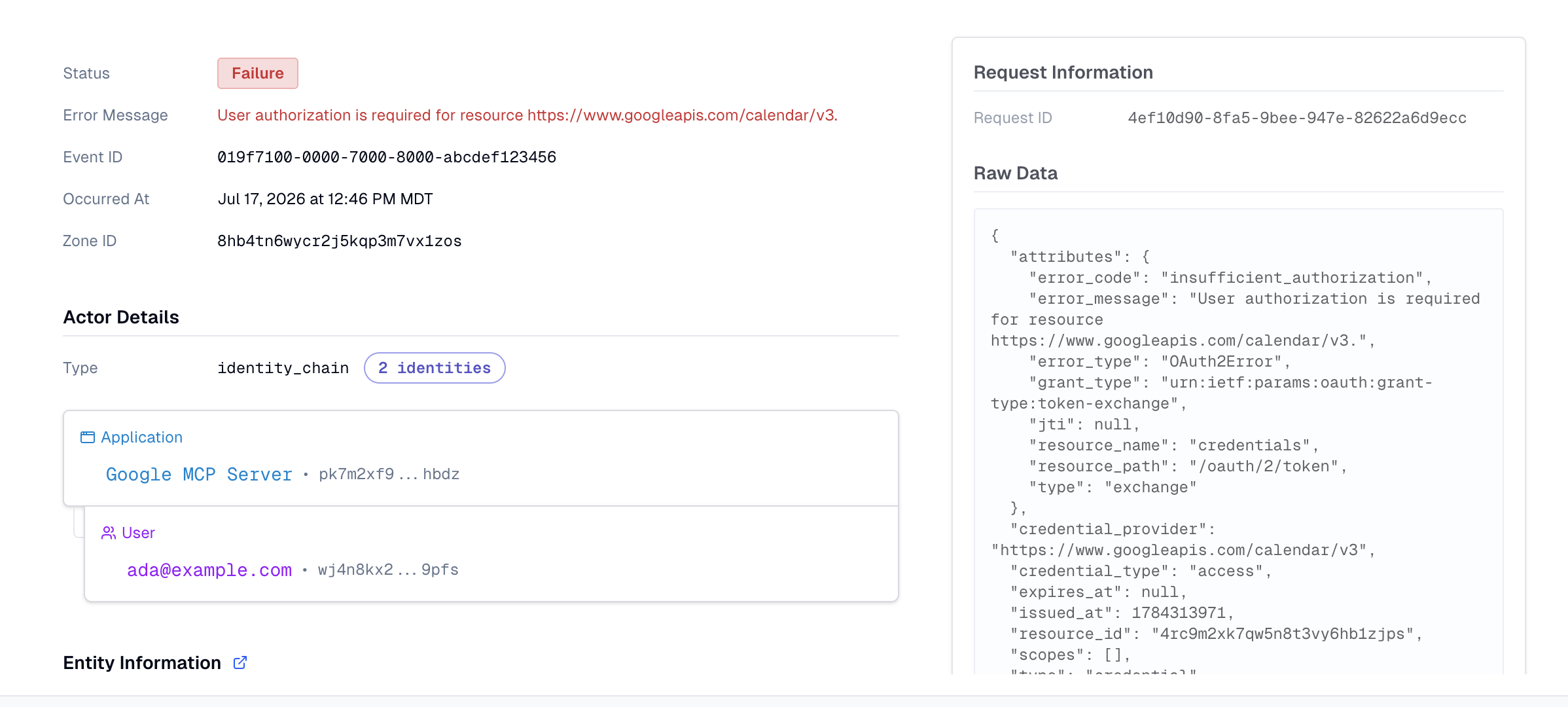
-
Retry from the Application. Once the current credential expires, trigger the Application again. Its next token request to Keycard should fail with
insufficient_authorization, and the Grants tab should still show the grant as Revoked.
Re-grant access
Section titled “Re-grant access”Revocation isn’t permanent. To restore access, the User goes back through the authorization flow and approves the consent screen again. Keycard records a new grant and credential issuance resumes.
For an Application configured with implicit consent, there’s no screen to approve — the grant is re-created automatically the next time the User runs the flow.
Related
Section titled “Related”- Access Policies — the standing rules that decide who’s allowed access in the first place
- Credential Issuance — how Keycard issues, refreshes, and brokers the credentials a grant unlocks
- Applications — the consent model and how grants are created
- Providers — the external providers behind brokered grants
- Audit Log Export — stream credential and access events to your SIEM
- Roles & Permissions — who can perform management operations