
Reading the Audit Log & Sessions
Read Keycard's Console Audit Log and Sessions views to trace an agent's identity, follow one action end to end, and verify that access changes took effect.
Keycard records every authentication, authorization, and credential it handles. The Console surfaces that record two ways: the Audit Log is the zone-wide stream of individual events, and Sessions organizes the same events around one authenticated session so you can follow an agent’s activity in order. They draw from the same underlying events — the difference is the lens.
This page is for reading those views: identifying who and what is on a single decision, tracing one action from sign-in to issued credential, telling the two views apart, and confirming that a change like a revocation actually took effect.
Before you begin
Section titled “Before you begin”- Sign in to the Keycard Console. Reading these views requires the Viewer Role or higher — Viewers can see sessions, users, and audit logs.
- Both views are zone-scoped. If the activity you’re verifying happened in a custom Zone, switch to that Zone first.
- Audit Log and Sessions are separate items in the left nav.
Read a single authorization decision
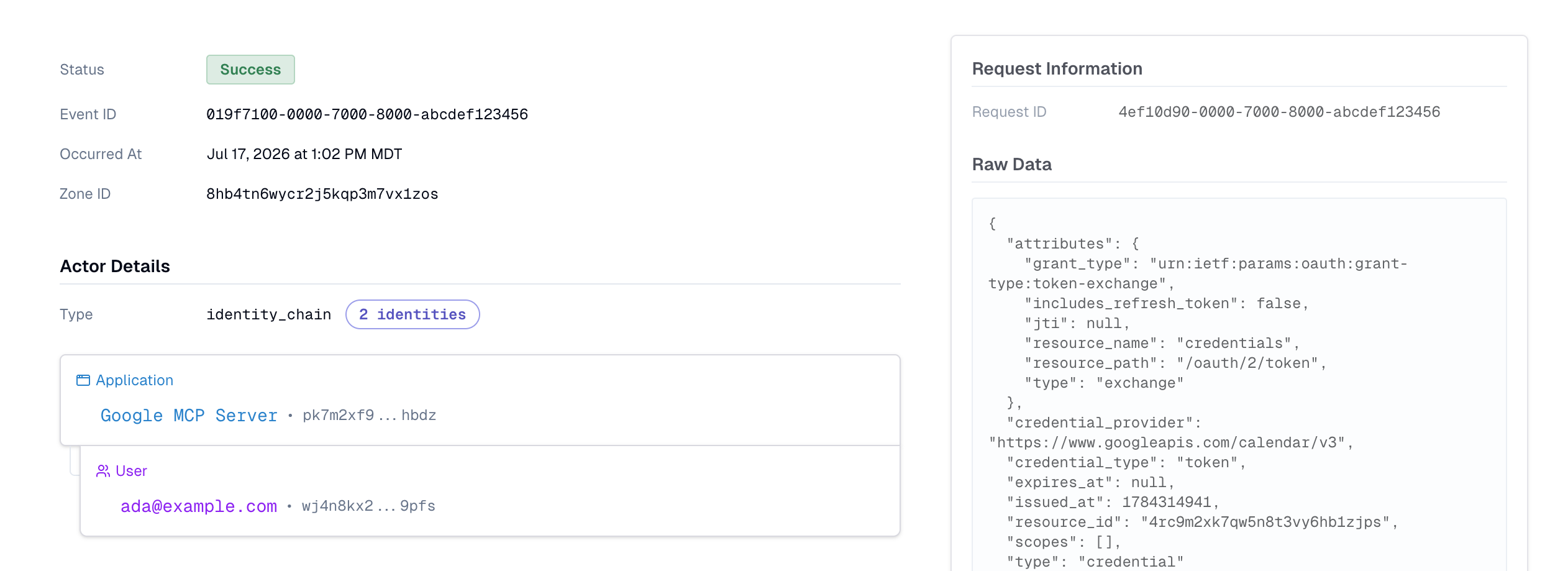
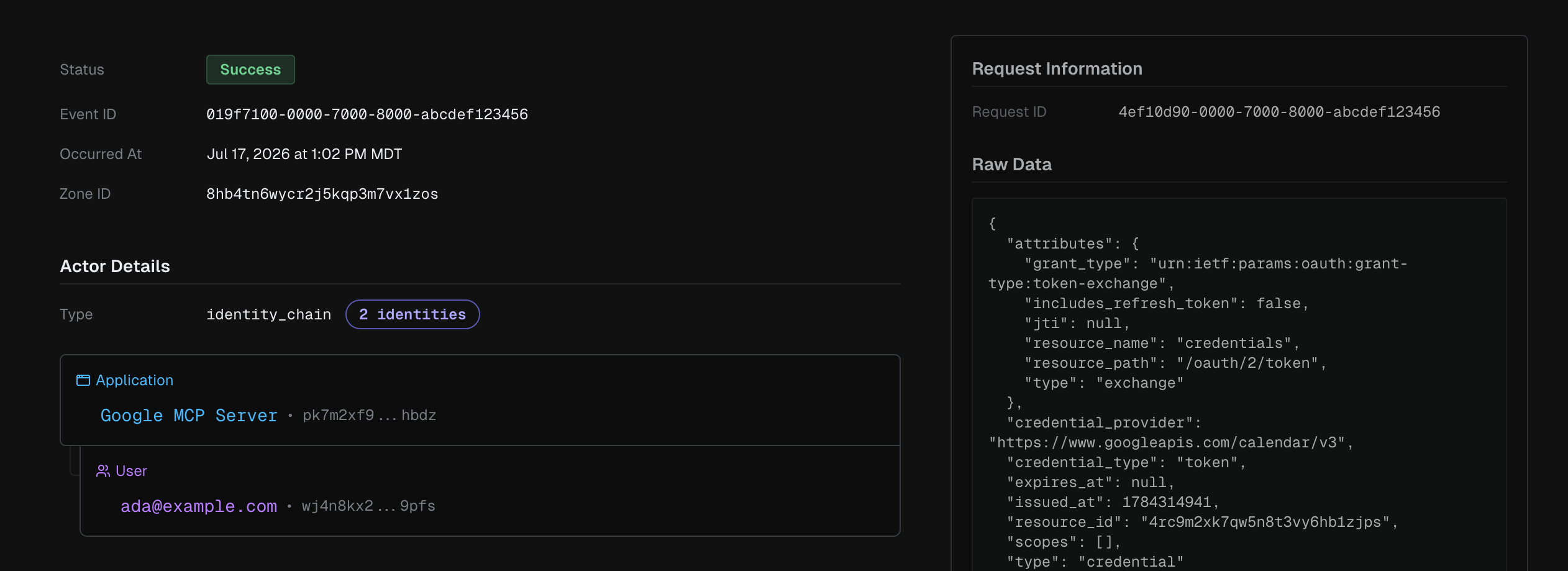
Section titled “Read a single authorization decision”Open the Audit Log from the left nav and select any event to expand its detail. A single event tells you the whole shape of one decision:
- Status —
SuccessorFailure. - Actor Details — the identity chain behind the call. Its Type is
identity_chain, and it lists each identity in the delegation path: the Application (the agent) and the User it acted for. This is how you read the composite identity on a decision — the User, the agent acting for them, and (through the entry below) the Resource they reached. - Entity — the Resource the call targeted (for example,
Google Calendar API). - Raw Data — the machine-readable record: the action (such as
credentials:issue), the requestedscopes, theresource_path(for example,/oauth/2/token), and — on a failure — theerror_code.
Trace one action end to end
Section titled “Trace one action end to end”A single action moves through a predictable lifecycle. In the Audit Log you’ll see the stages as separate events; in a Session timeline you’ll see them stitched together in order:
users:authenticate— the caller’s identity was verified.users:authorize— their access was checked against policy.delegated_grants:create— a grant recorded the User’s consent.credentials:issue— Keycard issued the short-lived credential.
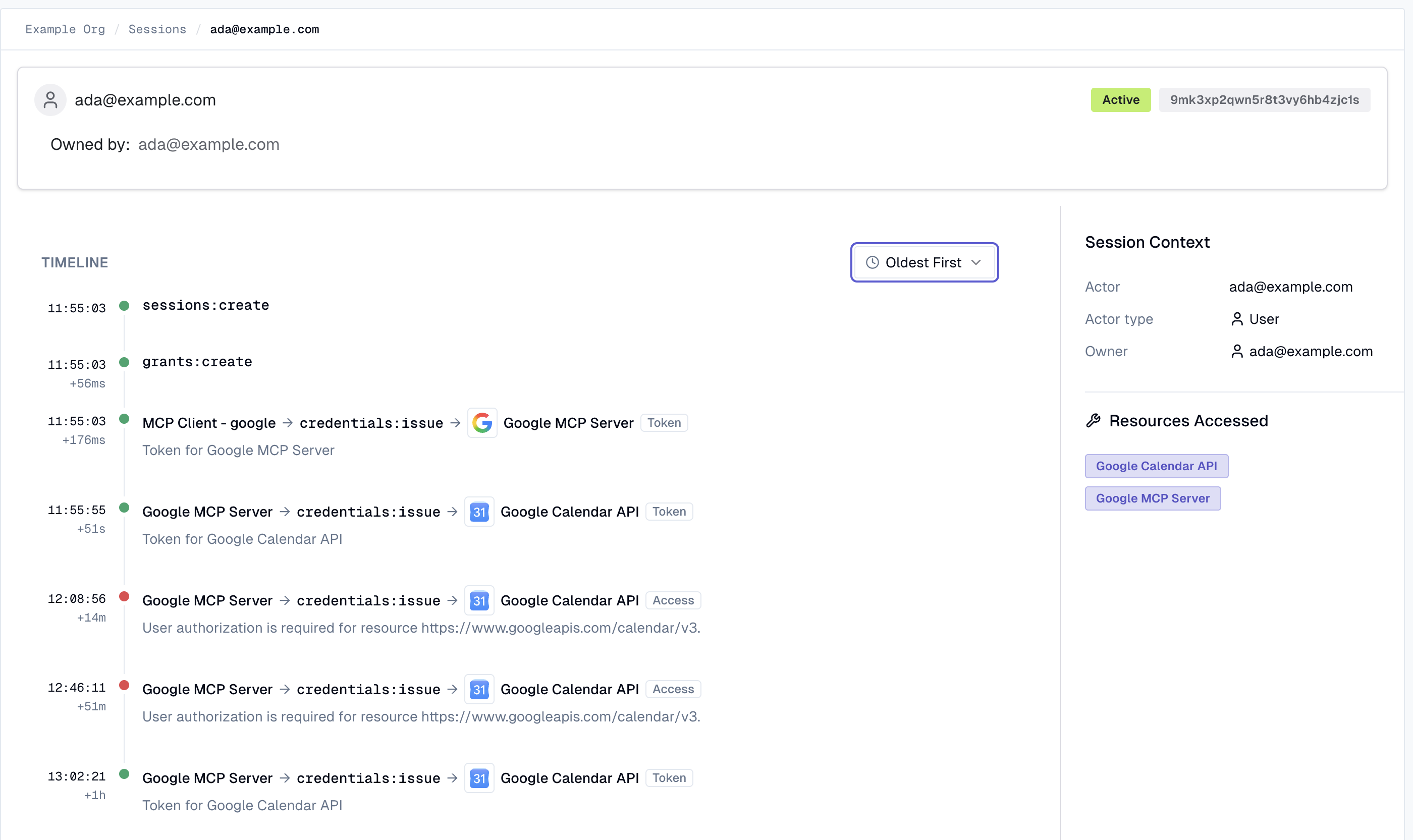
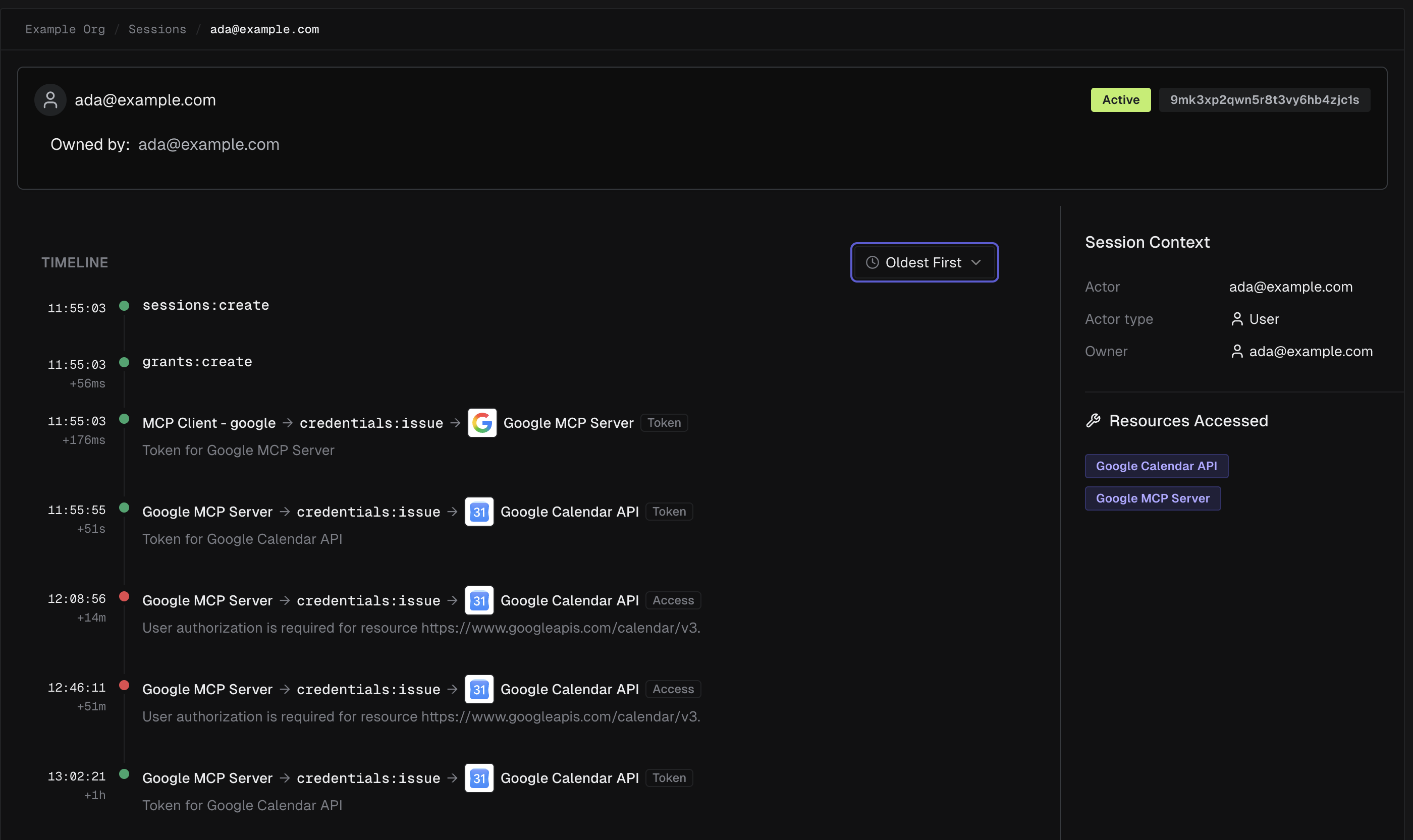
To follow one run, open Sessions and select a session. The Timeline lays out that session’s
events oldest-to-newest, rendering each credential exchange as a delegation hop
(agent → credentials:issue → Resource), so a two-hop flow reads as the client getting a token for
the MCP server, then the MCP server getting a token for the downstream Resource. Session Context
names the actor and owner, and Resources Accessed lists every Resource the session touched.
Find both sides of a deny
Section titled “Find both sides of a deny”When a call is refused, the Audit Log records both the attempt and the reason. The denied call appears
as a Failure event; the error_code in its Raw Data tells you which kind of denial it was:
access_denied— a policy denied the request. The Error Message names the deciding policy and policy set — for example, Access to “Google Calendar API” is denied by Policy “restrict-calendar-access” in version 1 of Policy Set “default-zone-policies” — so you can open Policies and read the rule that forbade it.insufficient_authorization— there was no grant to satisfy the request (the User never consented, or the grant was revoked). This is distinct from a policy denial.
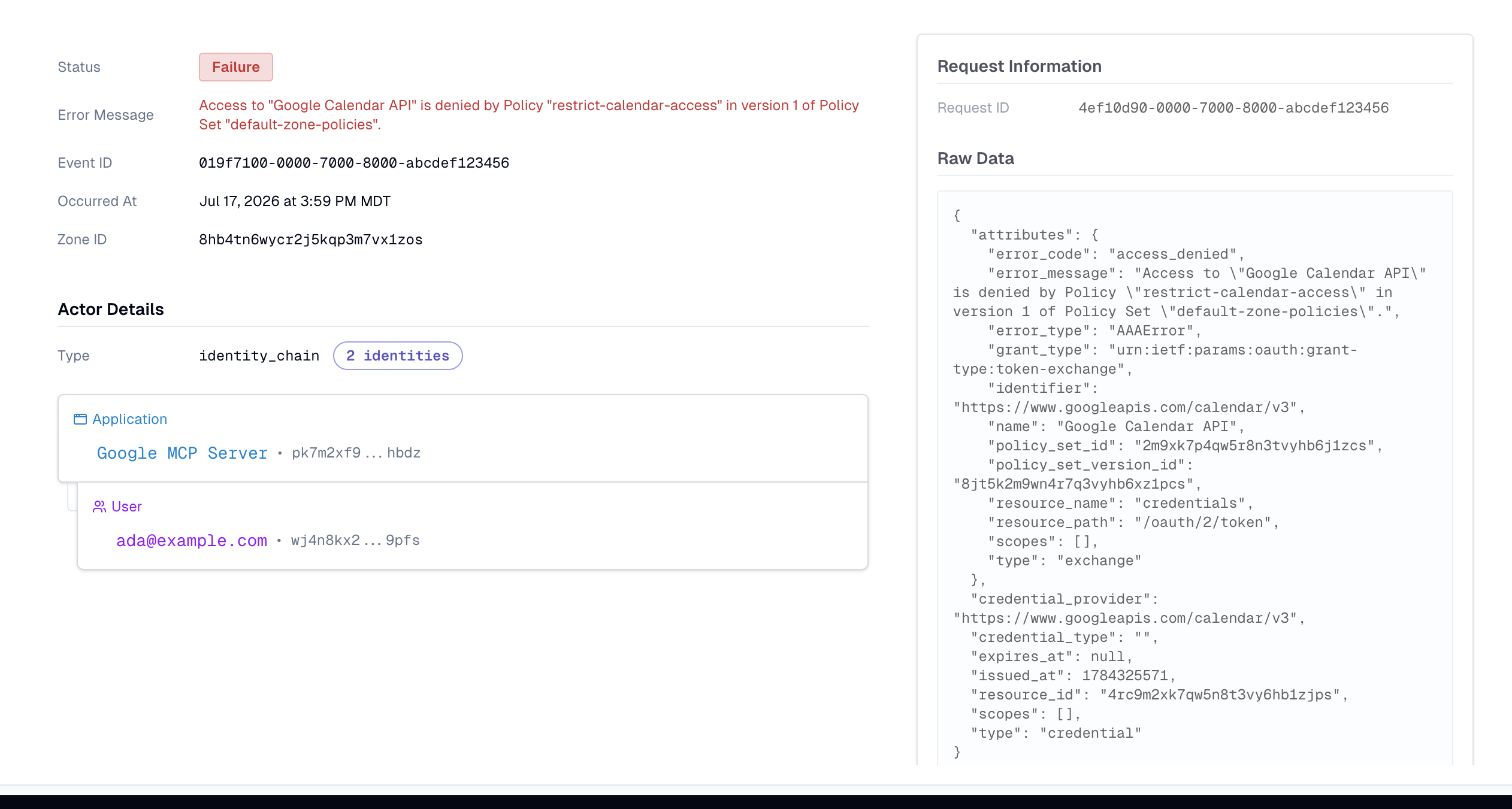
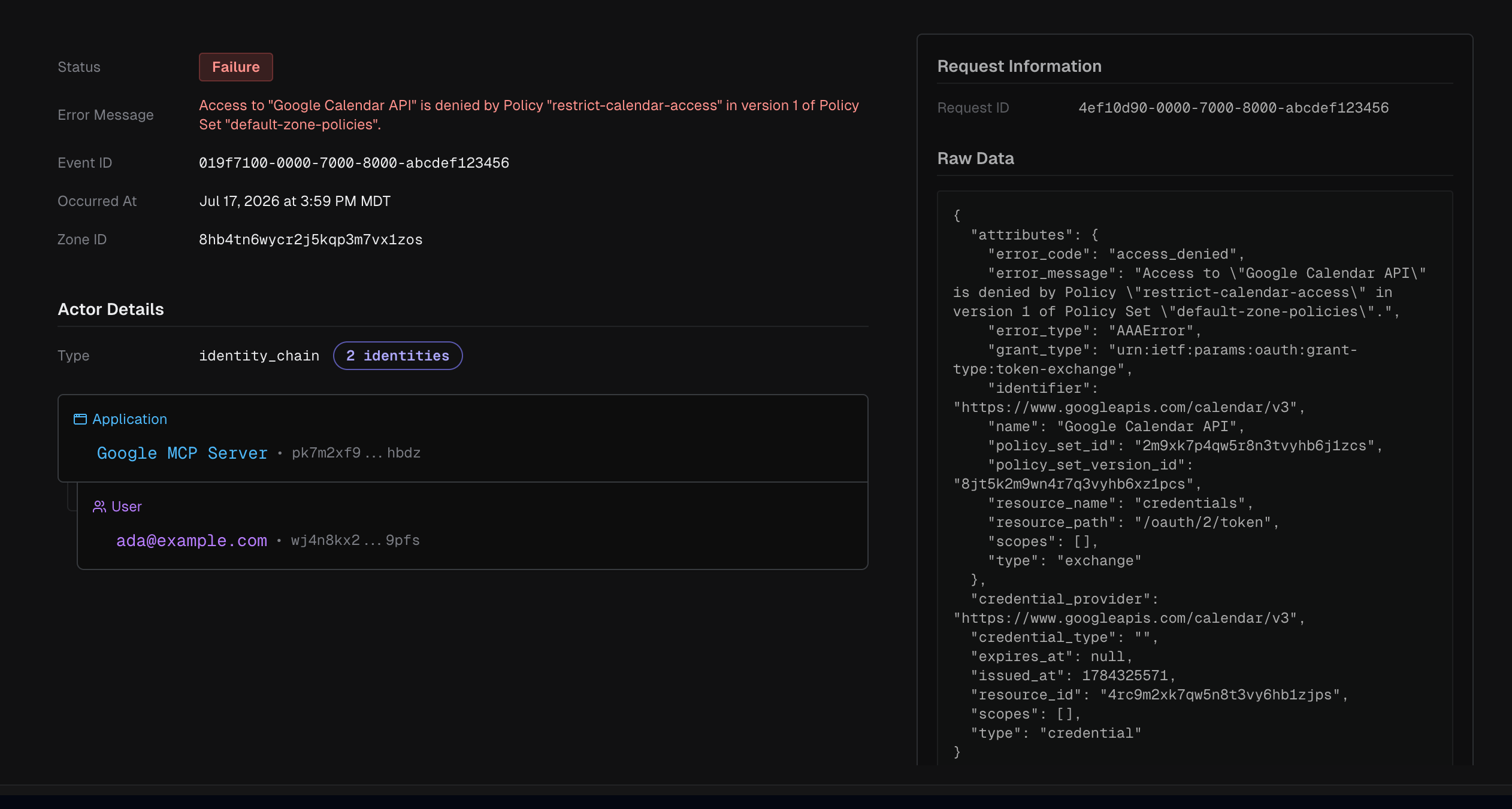
So “both sides” of a deny are always available: the Failure event is the call, and the deciding policy (or missing grant) named in the error is the reason.
Sessions vs. the Audit Log: when to look at which
Section titled “Sessions vs. the Audit Log: when to look at which”Use the Audit Log when you’re starting from an event — searching by Actor,
action, Resource, or category (API Call, Management Event, Service Event), or filtering to
Failures to find every refused call. Use Sessions when you’re starting from an agent run and want
its activity in order, including the tool calls made during that session.
Verify a revocation
Section titled “Verify a revocation”A common eval check is revoking access and confirming it took effect. The Audit Log shows both the change and its consequence:
-
Revoke the grant. Follow Revoke a Grant. The grant’s Status flips to Revoked.
-
Trigger the agent again. Its next credential request has no grant to satisfy it.
-
Find both sides in the log. The retry appears as a Failure
credentials:issueevent on/oauth/2/tokenwitherror_codeinsufficient_authorization, and the grant now shows as Revoked. From the grant’s actions menu, View in audit log deep-links straight to the event.
Where export fits
Section titled “Where export fits”Everything in the Audit Log can be streamed to your own AWS S3 bucket in OCSF (Parquet) format for your SIEM or data warehouse, delivered within the hour. Setup is a one-time, support-assisted step.
Related
Section titled “Related”- Revoke a Grant — withdraw an authorization and confirm it in the log
- Access Policies — the rules that decide
access_denied - Credential Issuance — how Keycard issues and chains the credentials you see
- Audit Log Export — stream events to your SIEM
- Roles & Permissions — who can view sessions and audit logs